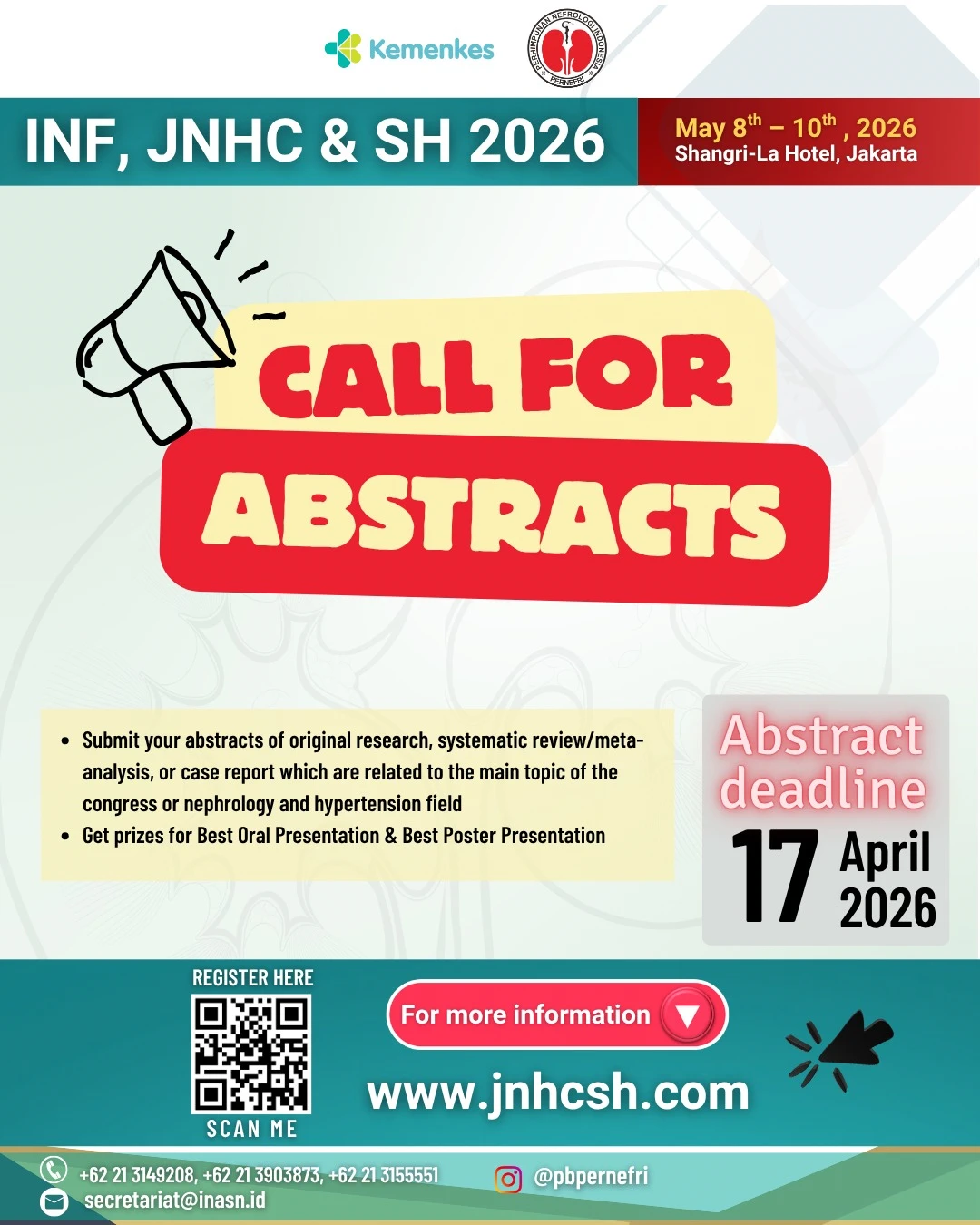
The 18th Indonesian Nephrology Forum, 25th Jakarta Nephrology and Hypertension Course, Symposium on Hypertension (INF-JNHC-SH) 2026 committee invites you to submit your abstracts of original research, systematic review/meta-analysis, or case report which are related to the main topic of the congress or nephrology and hypertension field. The Scientific Abstract Reviewer Committee will evaluate and select the abstracts based on quality, clarity and relevance on the main topic or nephrology and hypertension field.
ABSTRACT SUBMISSION & GUIDELINES
General Policies
- All abstracts must be prepared according to the correct format and requirements. Submissions will be returned to the author if not in the correct format and should be resubmitted to the committee with the exact format
- Abstracts submission will only be received online through INFJNHCSH 2026 website http://jnhcsh.com/abstract through the submission form.
- Faxed or mailed hard-copy abstract or abstract sent on disc/CD will not be accepted.
- There will be no limit to the number of abstracts for an author to submit.
- The Scientific Abstract Reviewer Committee will evaluate and select all abstracts for Oral Presentation or Poster Presentation
- Abstract submission will be opened until 17th April 2026.
- Notification of abstracts acceptance will be given to the presenting authors via email at the latest on 1st May 2026.
- All presenting authors, whose abstracts are accepted, must be registered to the INFJNHCSH 2026 event. Abstracts will not be processed until an abstract registration fee has been received.
Abstract Format Guidelines
A. Language English (Clear with accurate grammar and spelling of a quality suitable for publication)
B. Title Abstract titles should be concise and should not contain Please use Title Case and make sure to bold the entire title. Example: Title of Abstract
C. Author First name (s) or initials of first name (s) followed by family name.
D. Affiliation details of all authors: Department; institution/hospital; city; country.
E. Body
- Submit through abstract submission form
- Abstracts must not exceed a 250-word limit. The word limit relates only to the text of the abstract and does not include title, authors and institutions.
- No picture or graphic allowed in the abstract.
Case Report
This category is intended for educational, rare, or challenging clinical cases that provide meaningful insights for clinical practice.
Scope includes (but is not limited to):
- Rare kidney diseases or atypical clinical presentations
- Challenging dialysis, vascular access, or CRRT cases
- Unusual complications in CKD, dialysis, or kidney transplantation
- Diagnostic dilemmas in nephrology
- Innovative or multidisciplinary management approaches
Abstract structure:
- Background
- Case Presentation
- Discussion
- Conclusion
Original Article
This category is intended for original clinical, translational, or basic science research.
Scope includes (but is not limited to):
- Clinical nephrology
- Dialysis modalities and technologies (HD, PD, HDF, CRRT)
- Acute kidney injury and critical care nephrology
- Kidney transplantation and immunology
- Biomarkers and laboratory-based research
- Epidemiology and public health related to kidney disease
- Multidisciplinary and collaborative kidney care models
Abstract structure:
- Background
- Methods
- Results
- Conclusion
Systematic Review / Meta-analysis
This category is intended for structured evidence synthesis addressing focused clinical or research questions in nephrology.
Scope includes (but is not limited to):
- Therapeutic interventions in kidney disease
- Dialysis outcomes and technologies
- Biomarkers and diagnostic accuracy
- Prognostic factors in AKI, CKD, and transplantation
- Comparative effectiveness research
Requirements:
- Conducted in accordance with PRISMA guidelines
- Clearly defined research question (PICO format recommended)
- Description of literature search strategy and databases used
- Quantitative synthesis (meta-analysis) when applicable
Abstract structure:
- Background
- Methods
- Results
- Conclusion
ORAL PRESENTATION
- All applicants must submit an abstract to be presented in the INFJNHCSH 2026.
- The committee will evaluate the abstract which is categorized as Oral Presentation.
- If accepted as oral presentation, applicants should submit presentation slide (PPT format) through our submission form, and print the poster to be displayed on their designated poster board
- Applicants will present their paper in Oral Presentation session INFJNHCSH 2026 directly.
- Research posters will be displayed during INFJNHCSH 2026.
- The winner will be announced and rewarded during the INFJNHCSH 2026 closing ceremony on 10th May 2026
POSTER PRESENTATION
- All applicants must submit an abstract to be presented in the INFJNHCSH 2026.
- The committee will evaluate the abstract which is categorized as Poster Presentation.
- If accepted as poster presentation, applicants should print the poster to be displayed on their designated poster board.
- Applicants will present their paper in Poster Presentation session INFJNHCSH 2026 directly.
- Research posters will be displayed during the INFJNHCSH 2026.
- The winner will be announced and rewarded during the INFJNHCSH 2026 closing ceremony on 10th May 2026